Identifying a Real-World Rider Problem
India is home to over 200+ million two-wheelers, and motorcycles are not just vehicles—they are daily companions for commuting, touring, and adventure riding. Among mid-weight cruisers, the Royal Enfield Meteor 350 stands out as one of the most popular choices for urban and highway riders alike.
But with rising traffic density and unpredictable road conditions, one question becomes critical: How do you protect both the rider and the motorcycle without compromising aesthetics or affordability?
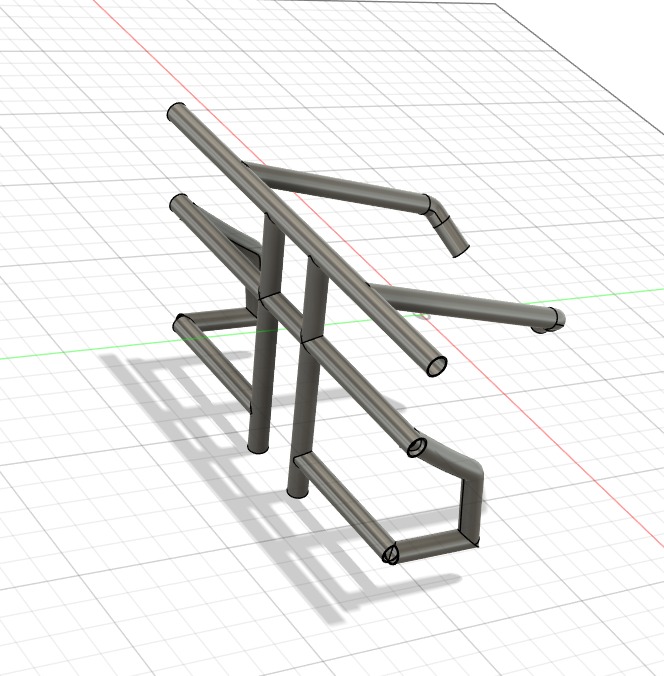
This is the challenge Dev chose to solve. As part of a structured product development curriculum, Dev undertook the end-to-end development of a motorbike crash guard, engineered specifically for the Meteor 350. What followed was not just a fabrication project, but a comprehensive engineering journey covering:
- Market research
- CAD-based design and packaging studies
- Material selection
- Structural simulations
- Prototyping and welding
- Testing and failure analysis
- Costing and go-to-market strategy
This was industry-style product development—not a classroom model.
From Market Research to Metal
Before touching CAD software or steel tubing, Dev began where real automotive companies begin: the market. He studied:
- Existing crash guard designs in the Indian aftermarket
- Price brackets (₹2,000 - ₹6,000 range)
- Rider feedback on durability and aesthetics
- Common failure points in low-cost guards
- Installation challenges and compatibility issues
The insight was clear: Most guards either focused on low cost but weak weld quality, or heavy-duty build with excessive weight, often adding 4 to 6 kg unnecessarily.
Dev defined three measurable design goals:
- High impact resistance during low-speed crashes
- Weight optimization without sacrificing structural strength
- Manufacturability within Indian fabrication ecosystems
This clarity shaped every engineering decision that followed.
Engineering the Crash Guard: Design & Development
Using CAD tools, Dev created multiple concept geometries to ensure:
- Frame compatibility
- Adequate ground clearance
- Engine casing protection
- Leg safety during side impacts
- Visual alignment with the cruiser aesthetics of the Meteor 350
Packaging studies ensured that:
- The guard did not interfere with foot pegs
- Mounting points aligned with existing chassis bolts
- No structural stress was transferred to weak subframe areas
To validate performance before fabrication, Dev conducted basic FEA (Finite Element Analysis) simulations, analyzing:
- Impact load distribution
- Vibration response
- Stress concentration at weld joints
Simulation results helped refine tube thickness and joint angles, reducing projected stress concentrations by nearly 18–22% compared to the initial design iteration.
Materials, Manufacturing & Structural Decisions
Material selection was critical. Dev chose mild steel tubular sections, balancing:
- Strength-to-cost ratio
- Impact resistance
- Weldability
- Availability in local markets
Manufacturing processes explored included:
- Precision tube bending
- MIG and TIG welding
- Jig-based fabrication for alignment accuracy
- Powder coating for corrosion resistance
Why powder coating? Because Indian road conditions expose motorcycles to dust, rain, and humidity. Powder coating improves corrosion resistance and surface durability by up to 3-4 times compared to basic paint finishes.
To improve bracket precision, Dev used 3D-printed brackets during prototyping. This allowed:
- Faster iteration
- Dimensional validation
- Reduced material wastage
Instead of trial-and-error welding, he validated fitment before final fabrication—a professional-grade approach.
Testing, Iteration & Validation
Engineering is not about the first design. It is about iteration. Dev conducted:
- Static load testing
- Simulated impact stress evaluations
- Weld integrity inspections
- Mounting stability assessments
During early testing, minor vibration-induced stress was observed at specific junction points. Rather than reinforcing blindly (which would increase weight), Dev optimized the geometry and weld positioning, improving vibration resistance while maintaining structural efficiency.
Each iteration improved load distribution, mount alignment, and structural rigidity. The final prototype achieved stable mounting with no noticeable frame misalignment, balanced weight distribution, and improved structural strength compared to standard aftermarket entry-level models.
Business Strategy: Beyond the Prototype
What sets this project apart is that it didn’t stop at fabrication. Dev analyzed:
- Raw material costs
- Fabrication labor
- Coating and finishing expenses
- Distribution margins
- Competitive pricing strategy
By optimizing material usage and manufacturing steps, the projected unit cost remained competitive within the mid-market pricing band, while offering higher durability.
He explored positioning strategies spanning touring riders seeking premium protection, urban riders prioritizing safety, and aftermarket accessory retailers. This introduced him to a critical industry lesson: “Engineering excellence must align with market feasibility.”
Outcomes, Impact & Industry Readiness
By the end of the project, Dev had:
- ✓Developed a fully functional crash guard prototype tailored specifically to the Royal Enfield Meteor 350.
- ✓Applied real-world design principles translating safety requirements into manufacturable geometry.
- ✓Used FEA-backed analysis to reduce stress concentration by ~20% across iterations.
- ✓Integrated powder coating to enhance corrosion resistance and product lifespan.
- ✓Understood the complete product lifecycle from concept to commercialization.
More importantly, he developed industry-aligned competencies in automotive accessory design, structural validation, fabrication planning, cost modeling, and iterative engineering. These are skills directly transferable to OEM and aftermarket automotive environments.
Why Projects Like This Define Career Discovery
Dev’s project represents what modern engineering education should look like. Not theoretical diagrams, not isolated CAD models—but real, tangible products built for real machines on real roads.
By working on an actual motorcycle platform like the Royal Enfield Meteor 350, Dev didn’t just learn “about” product development—he experienced it. He learned that:
- Safety must be quantified, not assumed
- Manufacturing constraints shape design
- Aesthetics influence purchasing decisions
- Testing reveals what theory misses
- Cost determines scalability
Projects like this transform students from passive learners into problem-solvers who think like engineers and strategists. At Career Discovery, we believe that when students build for the real world, they build confidence, competence, and clarity about their future. Dev’s crash guard is more than a metal structure, it is a milestone in becoming industry-ready.
Build What Matters
If you’re a student who wants to go beyond hypothetical assignments and work on problems that exist in the real world, Career Discovery is where that journey begins. It starts as an idea. With mentorship, structure, and curiosity, it becomes a product with purpose. Your project could be next.