Community Service
At Launchpad, community service is not an add-on. It is a learning journey where students collaborate with NGOs, design awareness programs, and engage directly with communities to understand real social challenges.
What Students Actually Do
Community service at Launchpad is hands-on. Students don’t observe from the sidelines; they plan, lead, and reflect.
Collaborate with NGOs
Students work closely with NGOs to understand community needs and design meaningful initiatives.
Run Workshops
Plan and conduct awareness or learning workshops for schools, NGOs, and local communities.
Lead Awareness Drives
Create and execute campaigns around education, sustainability, governance, and social issues.
Donate Books & Resources
Organise book drives and resource collections to support under-resourced communities.
How the Community Service Program Works
Each community engagement is thoughtfully designed and executed over approximately three months, ensuring depth, structure, and real impact rather than short-term volunteering.
Apply & Requirement Mapping
Week 1Students apply to the program and share their interests, availability, and learning goals. Our team understands the kind of community exposure and impact the student is looking for.
Ideation & Custom Planning
Week 1Based on the student’s profile and available NGOs in our network, we design a customised community initiative. This includes defining the objective, scope of work, and expected outcomes.
NGO Alignment & Introduction
Week 2We connect the student with a relevant NGO from our network. A dedicated Point of Contact (PIC) from Launchpad acts as a mediator to ensure smooth coordination between the student and the NGO.
Execution & Ongoing Support
Weeks 3–10Students execute workshops, awareness drives, visits, or donation initiatives. The PIC supports planning, scheduling, communication, and problem-solving throughout the engagement.
Reflection, Documentation & Closure
Weeks 11–12The initiative concludes with reflections, documentation, certificates, and mentor feedback. Students consolidate their learning and impact into structured outcomes.
NGO Collaborations
We work with a trusted network of NGOs across education, sustainability, governance, and community development. Students are matched with organisations based on their interests and the kind of impact they want to create.
Education-focused NGOs
Environmental & sustainability NGOs
Community welfare organisations
Governance & policy initiatives
Local grassroots organisations
Social awareness groups
Outcomes & Learning Gains
Every engagement is structured to generate tangible proof of learning — outcomes students can confidently present to universities, mentors, and scholarship committees.
Verified Certification
An official certificate detailing role, duration, and contribution.
Impact Report
A concise summary outlining objectives, execution, and community impact.
Mentor Evaluation
Qualitative feedback highlighting initiative, leadership, and teamwork.
What Students Receive
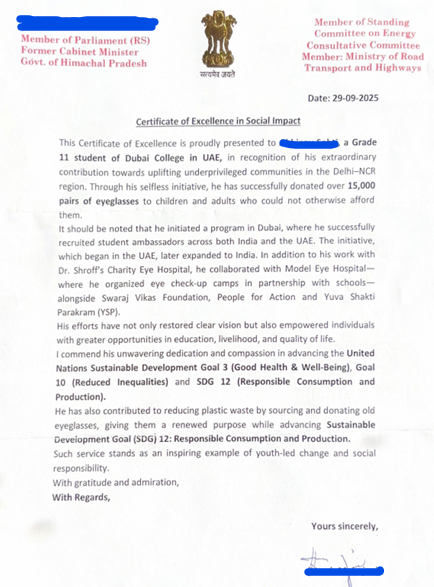
Upon successful completion, students receive a verified community service certificate acknowledging their role, commitment, and real-world contribution.
This certificate is commonly used in university applications, extracurricular portfolios, and interviews to demonstrate sustained civic engagement.